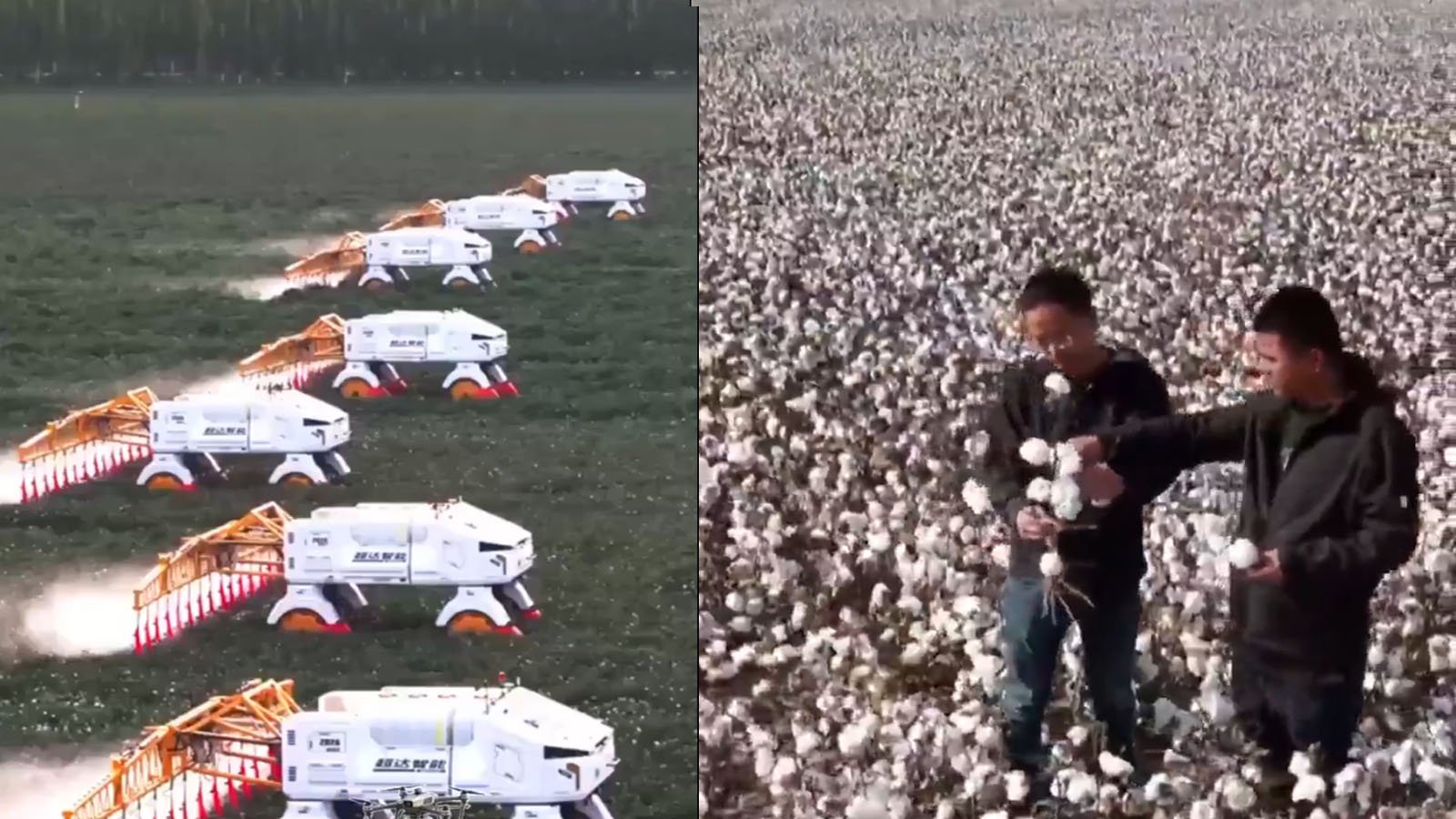
Urumqi: A smart farming project launched by two young agricultural specialists in China’s Xinjiang region has expanded from an initial 3,000 mu of cotton fields in 2021 to more than 2 million mu across the region, demonstrating the growing role of technology in modern agriculture.
The project, known as the “Super Cotton Field”, began in Yuli County, where two young agronomists, Ai Haipeng and Ling Lei, were tasked with managing 3,000 mu of cotton farmland using advanced agricultural technologies.
What started as an effort to develop an unmanned farming model has since expanded across Xinjiang, with artificial intelligence (AI), agricultural drones, smart irrigation systems and automated machinery helping manage different stages of cotton production.
According to a report published by Xinhua on October 15, the project’s management model had been adopted across more than 2 million mu by the end of 2025. The system has achieved an unmanned operation rate of around 75 per cent in field management.
The technology allows farmers to monitor crops, assess soil conditions and manage water, fertiliser and pesticide application through digital platforms. Drones equipped with automated systems can also carry out spraying and other crop-protection tasks with limited human intervention.
The project initially focused on irrigation, one of the most labour-intensive aspects of cotton cultivation. Its developers gradually introduced wireless smart valves, remote monitoring systems and AI-powered tools to improve efficiency and reduce the need for workers in the fields.
More recently, autonomous agricultural drones have further expanded the system’s capabilities, allowing operations such as spraying, refilling and recharging to be carried out with minimal manual involvement.
The wider adoption of the model reflects Xinjiang’s growing investment in agricultural mechanisation and digital technology. The region accounted for 92.8 per cent of China’s total cotton production in 2025, making it the country’s leading cotton-producing area.