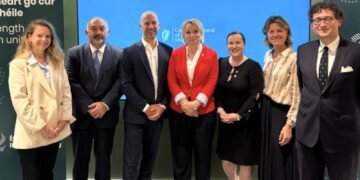
DUBLIN: Ireland must confront concerns over antisemitism within its society rather than dismissing international criticism as a politically motivated campaign, writer and Trinity College Dublin PhD candidate Rachel Moiselle has argued following a visit to Berlin focused on Holocaust education.
In a strongly worded commentary, Moiselle said conversations with international participants working in Shoah education had exposed the extent to which Ireland’s reputation was viewed with concern in some Jewish and Holocaust education circles.
She said several people were surprised to meet an Irish participant interested in Holocaust education, with some questioning why Ireland had relatively limited representation in the field.
Moiselle argued that the lack of Irish involvement was particularly striking given the country’s strong public identification with the struggles of oppressed communities and its emphasis on human rights.
She said the Holocaust, which resulted in the systematic murder of six million European Jews, should be a subject of particular interest to Irish society.
International concerns over Ireland’s reputation
According to Moiselle, conversations in Berlin repeatedly turned to questions about antisemitism in Ireland. She said people she met referred to a series of incidents that had contributed to negative perceptions of the country.
Among the examples she highlighted were antisemitic rhetoric on Irish social media, public support for Kneecap despite controversy surrounding statements made at performances, the proposed renaming of Dublin’s Herzog Park, and comments by former Taoiseach Leo Varadkar concerning an Irish Jewish child who had been kidnapped.
She also referred to the controversy surrounding Ireland’s 2025 Holocaust Memorial Day commemoration, when some attendees left or were removed following a protest during President Michael D Higgins’s address.
Another example cited was the Herbert Park Hotel controversy in October 2026, when the venue cancelled a booking for approximately 70 delegates attending an international conference on combating antisemitism. The Jewish Representative Council of Ireland raised concerns after hotel management reportedly questioned whether the conference had links to the Israeli Defence Forces. The hotel had not publicly responded to RTÉ’s request for comment at the time of its report.
Moiselle also mentioned the reported treatment of a Jewish couple in France by an Irish individual and the Irish government’s engagement with Francesca Albanese, the UN Special Rapporteur on the occupied Palestinian territories.
She argued that the incidents could not simply be dismissed as evidence of an international smear campaign against Ireland, saying they involved actions and statements originating within Irish society.
Criticism of Israel and antisemitism
A central part of Moiselle’s argument was that criticism of Israel should not be used to explain away every concern about antisemitism in Ireland.
She maintained that disputes involving Irish Jewish heritage, the treatment of Jewish people at Holocaust-related events and the cancellation of accommodation for an antisemitism conference should be examined separately from political criticism of the Israeli government.
The Herzog Park controversy became a particularly prominent example after Dublin City Council considered a proposal to remove the name of former Israeli president Chaim Herzog from the Rathgar park. Chaim Herzog was born in Belfast and spent much of his early life in Dublin.
The proposal triggered strong objections from Jewish community representatives and senior political figures. Taoiseach Micheál Martin said the move would erase an important contribution of Irish Jewish communities to the country’s history and described it as antisemitic. The proposal was subsequently withdrawn from the council agenda after officials raised legal concerns.
Moiselle said the distinction between legitimate criticism of Israeli government policy and hostility towards Jewish people and their heritage needed to be recognised more clearly in Ireland’s public debate.
Call for Ireland to address the issue
In her commentary, Moiselle said denying that Ireland faced a serious antisemitism problem was no longer a sustainable position, particularly in international discussions.
She argued that addressing the issue should begin with protecting the wellbeing and rights of Ireland’s Jewish community, but said the country’s international reputation was also at stake.
“Antisemitism is a poison that destroys everything it touches,” she wrote, warning that leaving it unchallenged could damage Ireland’s social values and its standing abroad.
Her remarks add to an ongoing debate in Ireland about antisemitism, freedom of expression, attitudes towards Israel and the treatment of the country’s Jewish community.
The commentary calls for a broader examination of how antisemitism is recognised and challenged, while highlighting the importance of distinguishing prejudice against Jewish people from political disagreement over Israel’s actions.