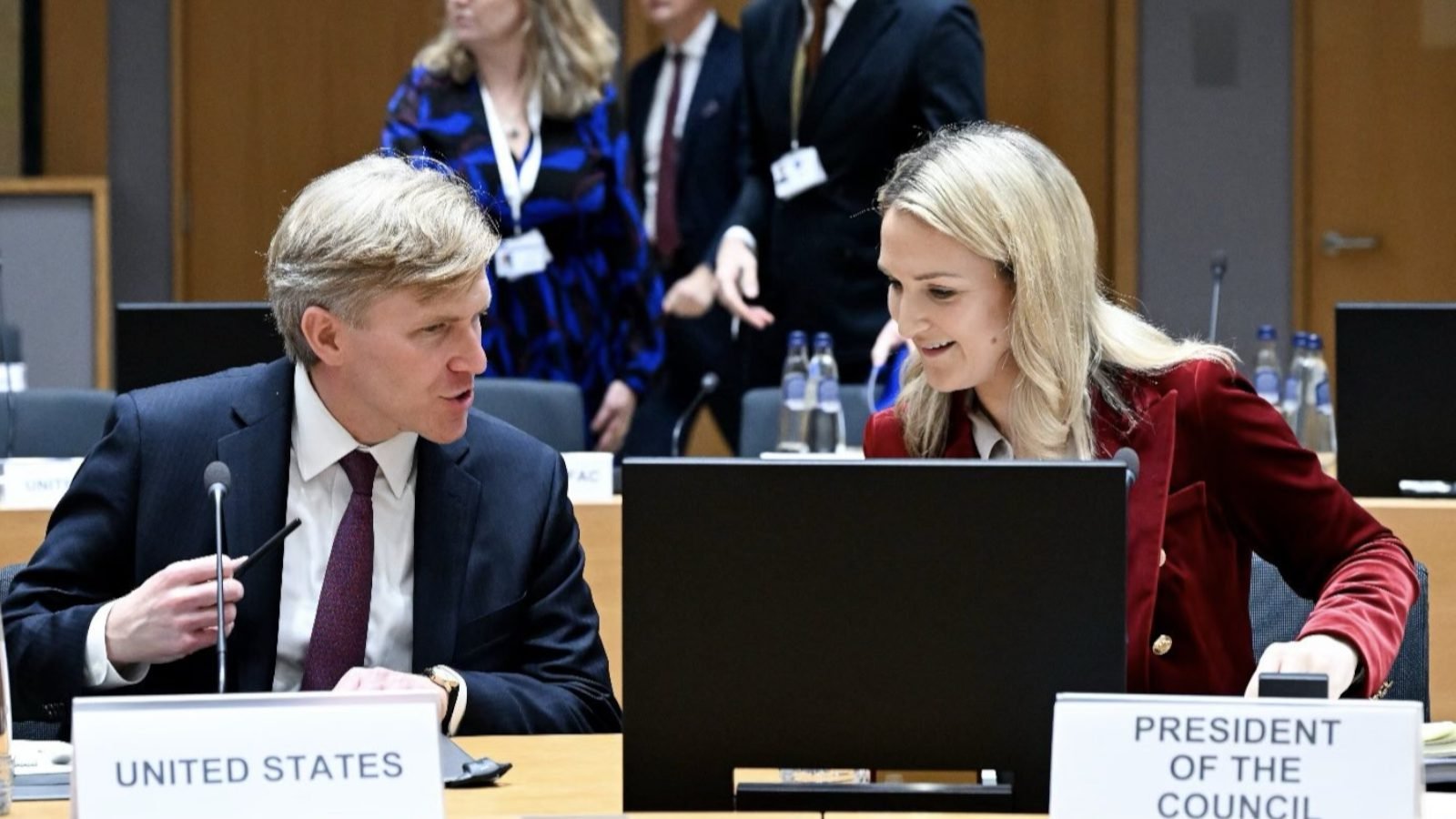
BRUSSELS: The United States has urged European allies to assume primary responsibility for their conventional defence within NATO, with Under Secretary of War for Policy Elbridge Colby calling for a more balanced transatlantic security partnership.
Addressing the European Union Foreign Affairs Council in its Defence configuration, Colby said the Trump administration wanted a stronger, more prosperous and more engaged Europe, but believed European countries should shoulder a greater share of the alliance’s military responsibilities.
Representing US Secretary of War Pete Hegseth, Colby described the changing relationship as a reset of the transatlantic bargain, arguing that a fairer division of defence responsibilities would leave both the United States and Europe more secure.
He said Washington’s approach was guided by what the administration calls “flexible realism and common sense”, with American foreign and defence policy increasingly focused on protecting US national interests and allocating military resources where they are most needed.
Under the administration’s revised strategic priorities, the United States intends to concentrate its military efforts on defending its homeland and the Western Hemisphere, as well as strengthening deterrence along the First Island Chain in the Indo-Pacific.
In Europe and on the Korean Peninsula, Washington expects its allies to take the lead in conventional defence, while American forces continue to provide critical but more limited support.
Colby said the strategy was designed to address the possibility of simultaneous conflicts in different regions, while strengthening deterrence and supporting diplomatic efforts to prevent such confrontations.
Europe praised for increasing defence spending
Colby credited European governments with making significant progress towards greater military responsibility, highlighting NATO leaders’ commitment to spending 5 per cent of gross domestic product on defence and security, including 3.5 per cent on core military capabilities.
He singled out Poland, Denmark, Finland, the Netherlands, Norway and Sweden for accelerating their defence investments, while praising Germany for advancing its commitments ahead of schedule and rebuilding its military industrial capacity.
He also highlighted France’s contribution to NATO’s force planning, saying European allies had moved quickly to fill capabilities affected by changes to the alliance’s force model.
Colby said the United States was conducting a Europe Posture Review to align its military presence on the continent with the emerging NATO framework. The review involves consultations with European governments and NATO military leadership.
He described the transition towards greater European responsibility as a historic development, while warning that further work would be needed to ensure the alliance remained prepared for future security challenges.
Washington backs European defence cooperation but opposes exclusionary policies
Colby also outlined the Trump administration’s position on European defence industrial cooperation, saying Washington was open to initiatives led by the European Union provided they remained accessible to American companies and other non-EU NATO allies.
He argued that European governments should avoid separate national defence strategies that could lead to duplicated spending, inefficient procurement and weaker military capabilities.
Instead, he called for European investment to be directed towards large-scale, effective military programmes that strengthen NATO’s collective defence.
However, he warned that excluding American defence companies from European markets would be counterproductive, potentially limiting access to advanced military technology and undermining the continent’s security.
Colby proposed greater transatlantic cooperation through joint ventures, licensed production and co-development, particularly in air and missile defence, artillery, precision munitions and resilient supply chains.
He cited Poland’s procurement of American military equipment alongside local industrial partnerships, as well as Germany’s production of Patriot missiles in Bavaria, as examples of cooperation between the two sides.
F-35 and defence industry at centre of transatlantic strategy
The US official also defended the F-35 fighter programme, describing it as a central capability for NATO’s future military strength.
He argued that attempts by smaller groups of countries to develop a competing aircraft independently would risk wasting European and Canadian resources without producing an equivalent capability in a timely manner.
Colby further stressed the importance of funding the American defence industrial base, warning that insufficient investment could restrict Washington’s ability to meet growing demand from European allies.
He said stronger industrial cooperation would allow the United States and Europe to expand production, improve military readiness and build more resilient supply chains.
Concluding his remarks, Colby said Washington wanted a Europe capable of defending itself, supported by economic growth, stronger military capabilities and continued cooperation with the United States.
He described a “strong, vigorous, and prosperous Europe” as the future the Trump administration hoped to build alongside its European allies.