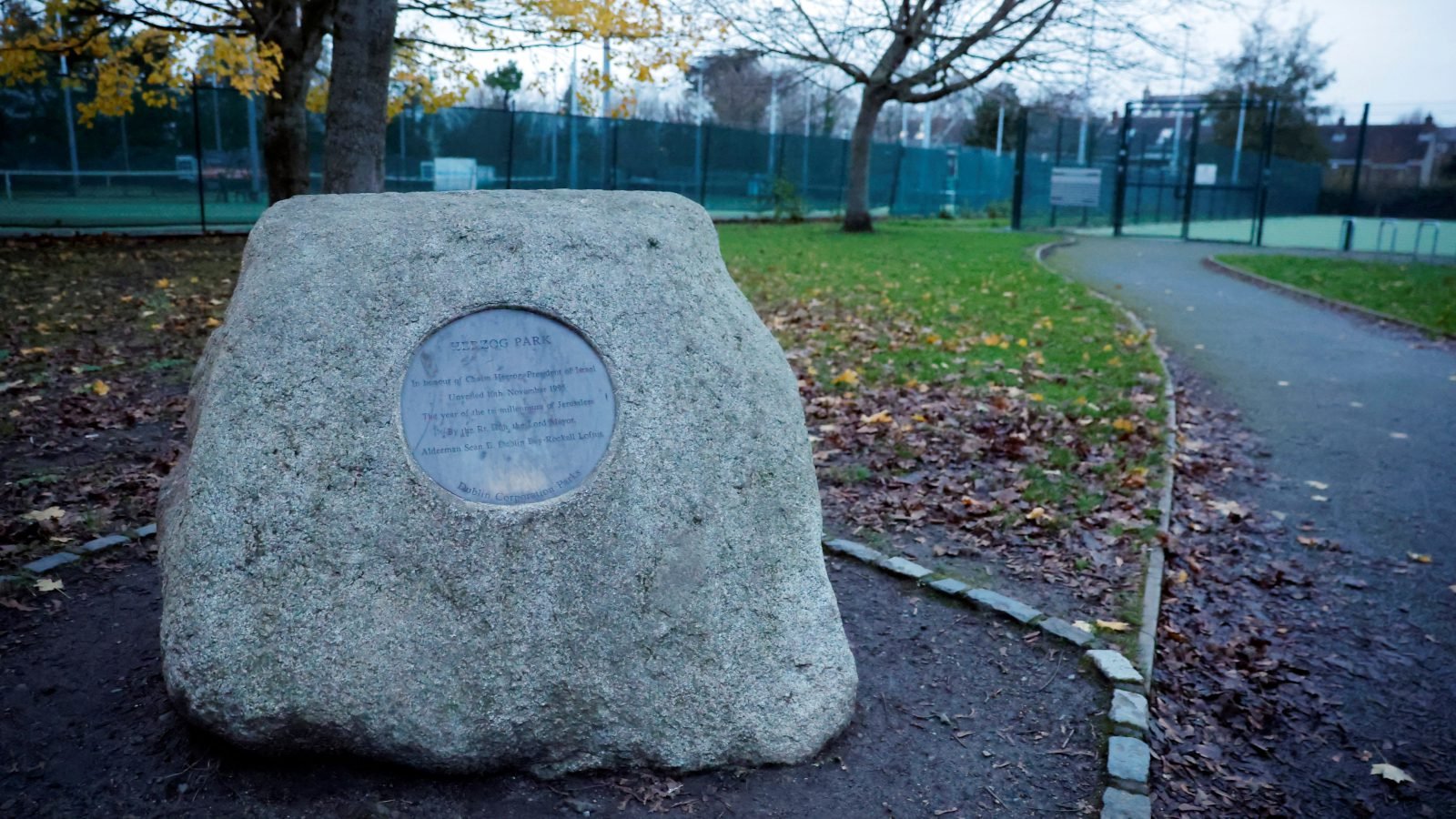
DUBLIN: A growing legal dispute over the proposed removal of former Israeli president Chaim Herzog’s name from a Dublin park has returned to the spotlight, with the Irish Government pledging to fully defend a High Court challenge brought by six Dublin City councillors.
The case centres on Herzog Park in Rathgar, named in 1995 in honour of Chaim Herzog, who was born in Belfast, grew up in Dublin and served as the sixth President of Israel from 1983 to 1993. His father, Rabbi Isaac Herzog, served as Chief Rabbi of Ireland.
The controversy first emerged in 2025 when Dublin City Council’s Commemorations and Naming Committee considered whether the existing name of the park should be removed and replaced following a public consultation.
A report submitted by Assistant Chief Executive Eileen Quinlivan, dated November 24, 2025, outlined the committee’s recommendation to remove the name ‘Herzog’ and begin a consultation process to identify a replacement.
The recommendation followed discussions at the committee’s July 24, 2025 meeting, where members considered the suitability of the existing name. The committee agreed, with one objection, that the name should be removed and that a public consultation should follow.
The proposal triggered widespread criticism, particularly from members of Ireland’s Jewish community and political figures who argued that removing Herzog’s name would undermine the recognition of Irish Jewish history.
Taoiseach Micheál Martin subsequently described the proposal as a denial of Ireland’s history and said it would be viewed as antisemitic. He called for the proposal to be withdrawn.
Council proposal halted after legal concerns
Despite the controversy, the proposed name change did not proceed to a vote at the Dublin City Council meeting on December 1, 2025.
Council officials subsequently acknowledged administrative and legal shortcomings in the process. The reports concerning Herzog Park and Diamond Park were withdrawn and referred back to the Commemorations and Naming Committee after the council was advised that the necessary legal framework for changing public place names was not in place.
The issue centred on Part 18 of the Local Government Act 2001, as amended in 2019, which provides for local authorities to change public place names but requires regulations governing secret ballots.
Six councillors take legal battle to High Court
The dispute took a new turn in June 2026 when six Dublin city councillors initiated judicial review proceedings against the Minister for Housing, Local Government and Heritage, James Browne.
The councillors involved are People Before Profit’s Conor Reddy, Sinn Féin’s Ciarán Ó Meachair and Mícheál Mac Donncha, and Independent councillors Cieran Perry, Nial Ring and Vincent Jackson.
They argue that the Government has failed to introduce regulations required under the Local Government Act, preventing local authorities from exercising their powers to rename public places.
The councillors are seeking a court order requiring the Minister to introduce the necessary regulations. Their legal challenge also concerns a separate proposal to rename Diamond Park in Dublin’s north inner city in memory of Terence Wheelock, who died following an incident involving Garda custody in 2005.
In the latest development, reported on November 23, 2026, the State confirmed that it would fully defend the legal challenge. The High Court had granted the councillors permission to pursue judicial review, with the proceedings adjourned until February.
Questions over legal costs and taxpayers’ money
The latest court proceedings have also raised questions about the potential financial implications for taxpayers, particularly if the case continues through further stages of litigation.
The central question is who will ultimately bear the legal costs associated with the councillors’ challenge and the Government’s defence.
However, no confirmed figure for the legal costs, or a final determination of who will be responsible for them, was established in the latest reporting. Claims that the proceedings could cost hundreds of thousands of euros should therefore be treated as estimates rather than confirmed expenditure.
The dispute has consequently developed beyond a disagreement over the name of a small Dublin park, becoming a wider legal and political debate about local authority powers, public commemorations and the recognition of Ireland’s Jewish heritage.
For Herzog’s supporters, the issue is about preserving the historical contribution of an Irish-born Jewish figure whose life connected Belfast, Dublin and international public service. Critics of the proposed renaming have argued that his legacy should not be removed from public recognition because of disagreements over Israeli government policy.
The High Court proceedings are now expected to determine the legal questions surrounding the Government’s obligations and the powers available to local authorities.