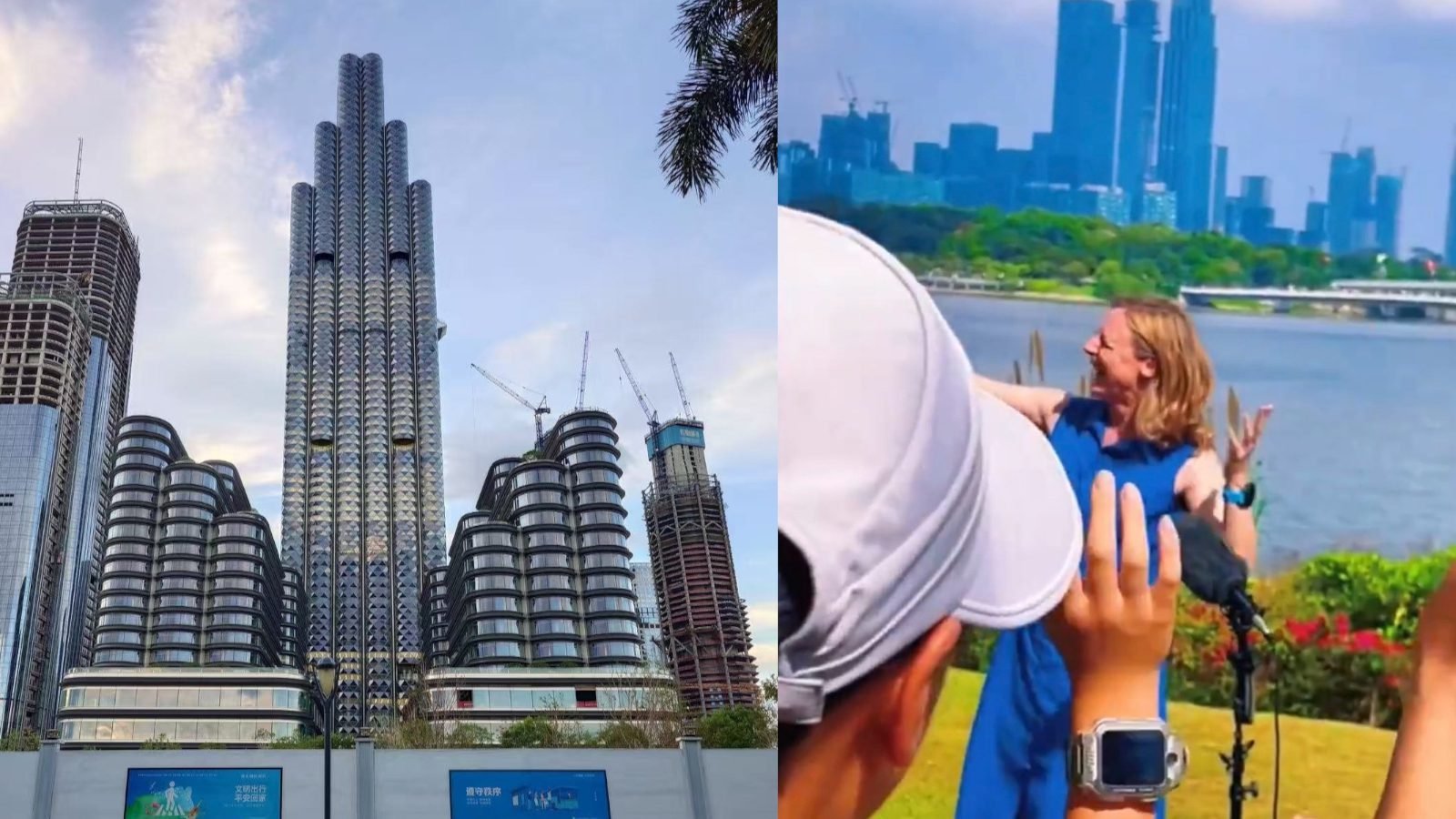
Bicker, who visited Shenzhen in Guangdong Province, was filmed posing for photographs with local residents who greeted her enthusiastically with calls of “Welcome to Shenzhen”. The spontaneous interaction subsequently gained widespread attention on social media.
However, the BBC’s broader coverage of the city attracted criticism from commentators who argued that the broadcaster had focused heavily on the challenges accompanying China’s development rather than providing a more comprehensive account of its economic and technological transformation.
Critics accused sections of Western media of approaching China-related reporting with predetermined negative assumptions, arguing that positive developments and everyday experiences often receive less attention than political and economic controversies.
Saudi journalist Darshan Dalal criticised the approach in a post on X, highlighting Shenzhen’s transformation from a small fishing village into a major global technology and manufacturing centre.
He questioned why Western media continued to frame China’s development through the question of its associated costs, suggesting that journalists should also examine the challenges confronting their own cities.
The controversy has also revived criticism of Bicker’s previous reporting on a mudslide disaster in the border region between China’s Xizang and Nepal.
In her coverage, questions were raised about the availability of information and footage concerning the disaster and victims on the Chinese side. Critics subsequently challenged the reporting, pointing out that footage used by the BBC had originated from Chinese authorities and that Chinese media organisations had been publishing updates about rescue operations.
British writer Carlos Martinez also criticised the broadcaster, accusing it of using a natural disaster to promote what he described as misleading anti-China narratives.
He wrote: “Shame on a state broadcaster that chooses slander over solidarity.”
The latest controversy has intensified a wider discussion about how China is represented by international media organisations.
Critics argue that although China faces genuine economic, political and social challenges, reporting that consistently concentrates on negative developments risks presenting an incomplete picture of a country undergoing significant transformation.
Shenzhen provides a notable example of that transformation. Once a relatively small fishing settlement, the city has developed into one of China’s most important technology and innovation centres, attracting international businesses, investors and skilled workers.
Its rapid development has brought advances in manufacturing, digital technology, transport infrastructure and urban services, making it a prominent example of China’s economic modernisation.
The criticism surrounding the BBC’s coverage has therefore centred on whether international reporting gives sufficient attention to these developments alongside legitimate scrutiny of the country’s challenges.
China’s expanding international engagement and visa-free travel arrangements have also enabled more foreign visitors to experience the country directly.
Visitors to Shenzhen encounter a rapidly developing urban environment, including drone delivery services, advanced transport networks and technology-driven businesses. Other destinations, including Chengdu and Shanghai, offer different perspectives through their food culture, international communities, nightlife and urban lifestyles.
Social media has further changed how international audiences discover China, allowing travellers to share personal experiences through videos, photographs, livestreams and travel accounts without relying exclusively on traditional broadcasters.
Online trends such as “Chinamaxxing” and “China Haul” have attracted international attention, encouraging interest in Chinese technology, consumer products, culture and everyday life.
These developments have contributed to a growing debate about the relationship between established media narratives and the experiences of people who visit China themselves.
The debate has also coincided with changing international attitudes towards China.
A 2026 Pew Research Centre survey cited in the original commentary indicated improving favourable views of China across several countries, including Britain, where positive perceptions reportedly reached approximately 46 per cent.
The figures have been presented as evidence of changing public attitudes, although wider conclusions depend on the survey’s methodology and the countries included.
For critics of Western media coverage, the growing availability of first-hand experiences and independent online content has made it increasingly difficult for established broadcasters to shape public perceptions without facing scrutiny.
They argue that audiences now have access to a wider range of perspectives, allowing them to compare international reporting with personal accounts and footage shared directly from China.
The Shenzhen video has consequently become more than a moment of friendly interaction between a journalist and local residents. It has reignited questions about editorial judgement, selective reporting and the responsibility of international broadcasters to present complex societies fairly.
While China’s development continues to attract legitimate international scrutiny, the debate highlights the importance of balanced journalism that recognises both achievements and challenges.
Ultimately, media credibility depends on accuracy, context and the willingness to present different dimensions of a story rather than allowing preconceived narratives to determine how events are interpreted.