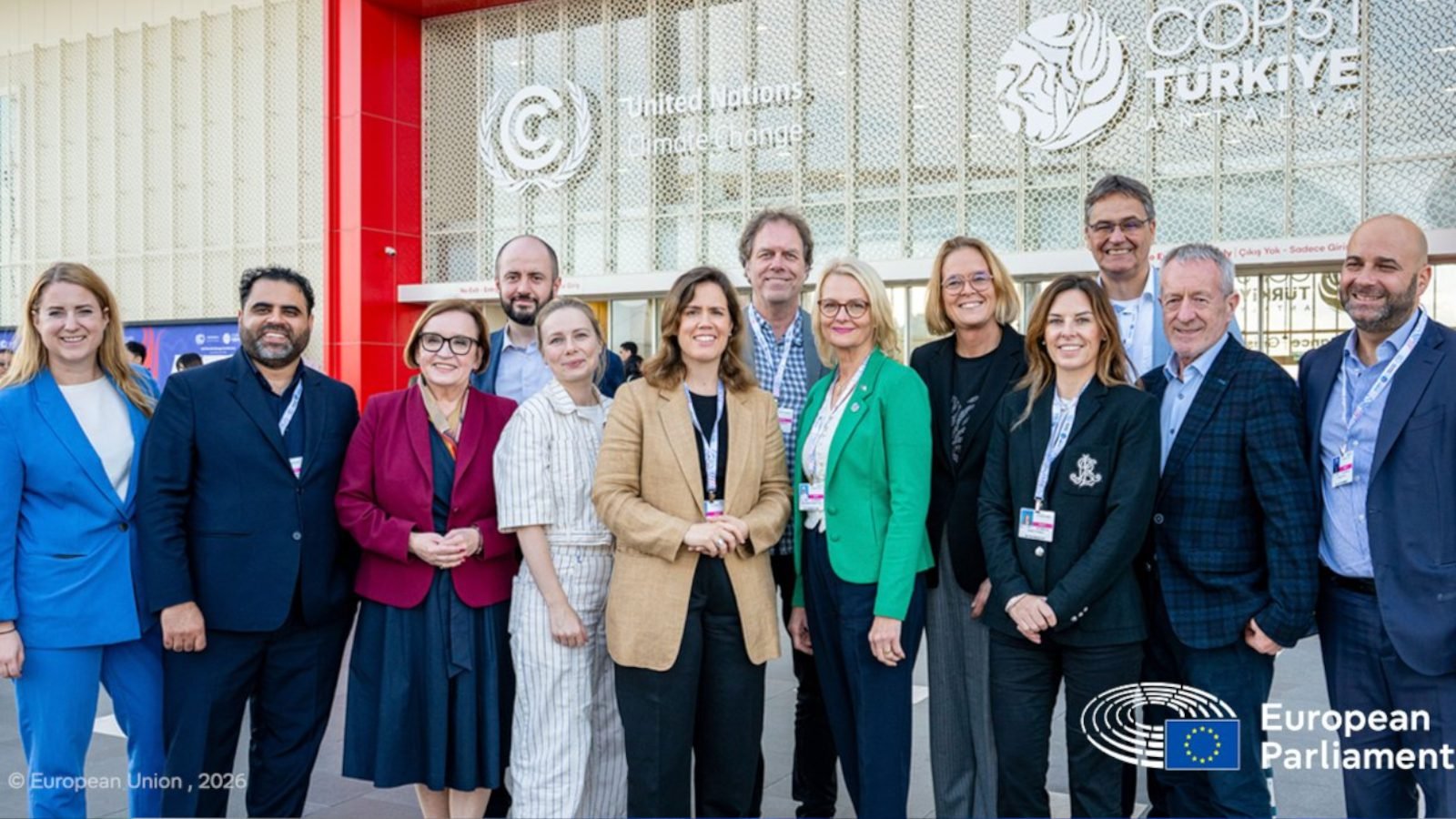
ANTALYA, Türkiye: European Parliament lawmakers have warned against weakening global climate commitments as negotiations at the United Nations Climate Change Conference (COP31) enter their final stage, insisting that countries must turn existing promises into concrete action rather than dilute previously agreed targets.
The European Parliament delegation attending the summit in Antalya called for stronger climate ambition, greater investment in electrification and the implementation of commitments made under the Paris Agreement.
Delegation chair Lídia Pereira, a Portuguese member of the European People’s Party (EPP), said COP31 must become a turning point for implementing climate commitments, warning that Europe could not accept a final agreement that omitted the international pledge to transition away from fossil fuels.
“COP31 must be the COP of implementation,” Pereira said, referring to the discussions held with countries ranging from major economies to vulnerable island states.
She welcomed references to electrification in the draft cover decision but criticised the apparent removal of language reflecting the agreement reached at COP28 on transitioning away from fossil fuels.
Pereira argued that decarbonisation was not simply an environmental necessity but also an opportunity to strengthen economic growth and energy security across Europe.
Her comments came as negotiators worked towards a final agreement on emissions reduction, energy transition, climate finance and adaptation measures.
EU lawmakers warn climate action is moving too slowly
The delegation’s vice-chair, Heléne Fritzon, a Swedish member of the Socialists and Democrats (S&D) group, said the European Parliament had focused on pressing the European Commission to maintain ambitious climate positions while engaging with international partners.
Fritzon said lawmakers had held discussions with representatives from Brazil, China and South Africa, as well as Ethiopia’s incoming COP32 presidency.
The delegation also exchanged views with civil society representatives on emerging climate targets and carbon-pricing systems in different parts of the world.
She described the UN climate conferences as an essential platform for international cooperation but warned that progress remained too slow.
“As warming is set to overshoot 1.5°C, we must really deliver on our promises,” Fritzon said.
The 1.5°C threshold refers to the long-term temperature limit identified in the Paris Agreement, which seeks to keep global warming well below 2°C while pursuing efforts to limit the increase to 1.5°C above pre-industrial levels.
Electrification placed at centre of European climate strategy
Electrification was another major focus of the European Parliament delegation’s work in Antalya.
On November 19, the Parliament hosted a side event at the EU Pavilion titled Electrification for Energy Security and for Economic and Climate Resilience.
The discussion examined how expanding the use of electricity across transport, industry, buildings and other sectors could support emissions reduction while strengthening energy security and economic resilience.
The issue has become increasingly important for European policymakers as countries seek to reduce dependence on imported fossil fuels, expand renewable energy generation and modernise electricity infrastructure.
A joint press conference involving Pereira and European Commissioner for Climate, Net Zero and Clean Growth Wopke Hoekstra was also held on November 18 to discuss the EU’s position at the summit.
EU’s 2040 climate target raises pressure for action
The European Parliament’s intervention at COP31 comes as the European Union advances its own legally binding climate commitments.
In February 2026, Parliament approved an amendment to the European Climate Law establishing a target to reduce the bloc’s net greenhouse gas emissions by 90 per cent by 2040 compared with 1990 levels.
At least 85 per cent of the reduction must be achieved within the EU, while the framework allows a limited contribution from international carbon credits under specified conditions.
The amended law entered into force in April 2026, providing a further milestone on the EU’s pathway towards climate neutrality by 2050.
The European Parliament plays a central role in shaping EU climate and energy legislation alongside the Council of the European Union. It must also give its consent before the bloc can conclude international agreements.
COP31 negotiations face decisive test
COP31 is being held in Antalya from November 9 to 20, 2026, under Türkiye’s presidency, with Environment, Urbanisation and Climate Change Minister Murat Kurum serving as COP President.
Australia’s Minister for Climate Change and Energy, Chris Bowen, is serving as President of Negotiations.
The summit has brought governments, international organisations, climate experts and civil society representatives together to address the implementation of the Paris Agreement and strengthen global responses to climate change.
With negotiations approaching their conclusion, the European Parliament delegation has called for a final agreement that preserves previous commitments, accelerates the energy transition and delivers measurable progress.
The dispute over the language on fossil fuels has emerged as a significant issue, highlighting the challenge of securing consensus among countries with different economic circumstances, energy requirements and climate priorities.
European lawmakers maintain that the credibility of the global climate process depends on translating agreed commitments into practical measures, rather than allowing established ambitions to weaken during negotiations.