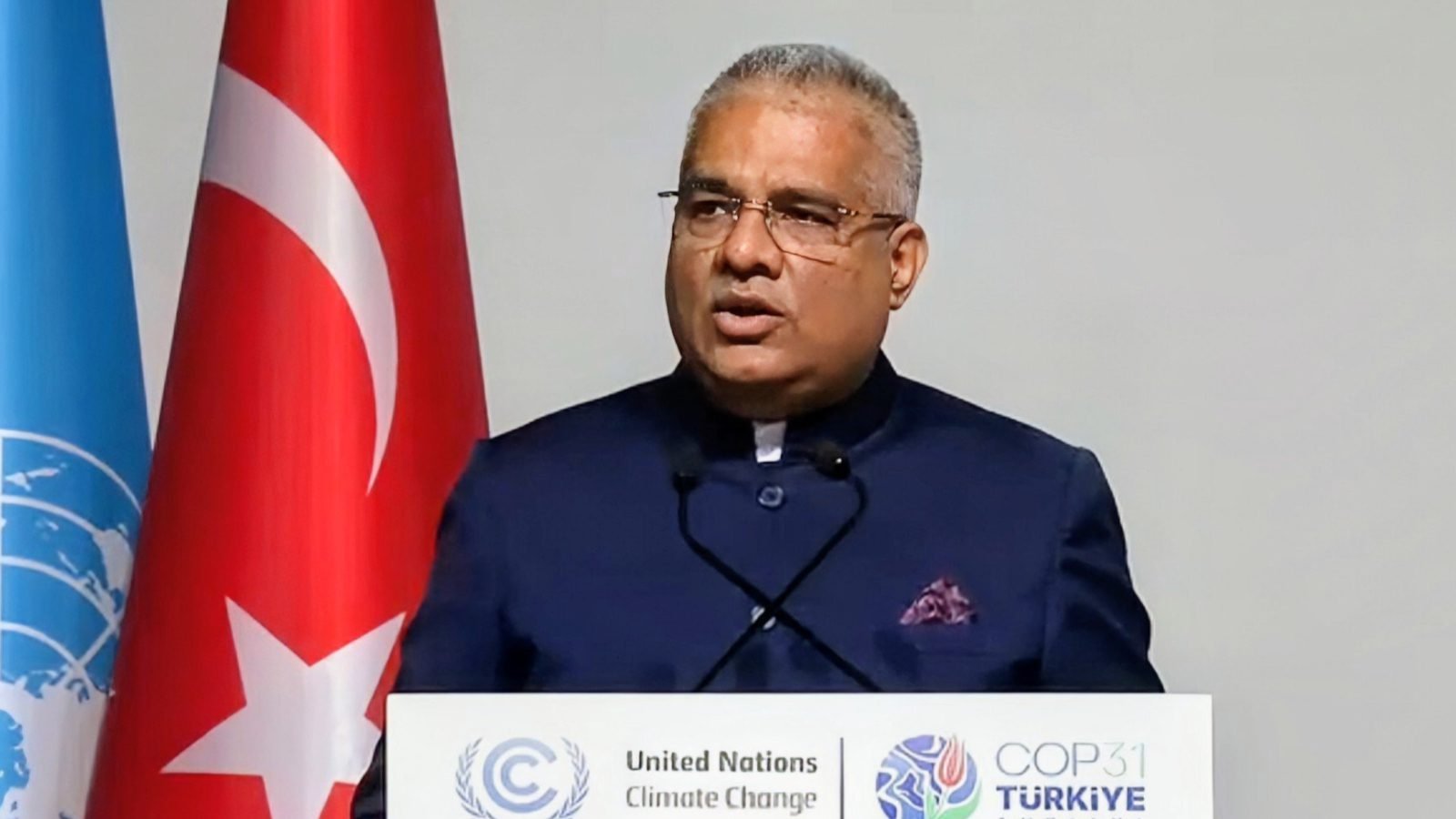
ANTALYA, Türkiye: India has challenged developed nations to take greater responsibility for the climate crisis, warning that countries in the Global South must not be forced to bear the burden of historical greenhouse gas emissions in the name of higher climate ambition.
Delivering India’s national statement at the 31st United Nations Climate Change Conference (COP31) in Antalya on November 18, Union Environment, Forest and Climate Change Minister Bhupender Yadav called for global climate action based on equity, climate justice and the principle of Common but Differentiated Responsibilities and Respective Capabilities (CBDR-RC).
The minister argued that the world’s warming was the consequence of nearly two centuries of industrialisation and economic growth in some countries, driven by extensive greenhouse gas emissions.
He said it would be unjust to expect developing nations to shoulder the consequences of those historical emissions while also meeting increasingly demanding climate targets.
“Global South cannot be made to bear the burden of historical emissions in the name of ‘higher ambition’,” Yadav said, stressing that developing countries should not have to choose between climate action and their legitimate right to development, better living standards, healthcare and education.
He also described equitable access to the remaining global carbon budget as non-negotiable, arguing that developing economies must retain sufficient room to pursue economic growth while contributing to international climate efforts.
A central part of India’s position at COP31 was the need for developed countries to fulfil their climate-finance obligations without further delay.
Yadav called for greater financial support to developing nations, arguing that climate commitments must be accompanied by the resources required to implement them.
Under Article 9.1 of the Paris Agreement, developed countries are required to provide financial resources to assist developing countries with mitigation and adaptation efforts.
India has maintained that such funding should be predictable, largely public and concessional, rather than increasing the debt burden of vulnerable economies.
The minister also cautioned against unilateral trade measures introduced in the name of climate action, warning that they could penalise developing countries and undermine their economic interests.
His remarks reflect India’s longstanding concerns over measures such as the European Union’s Carbon Border Adjustment Mechanism (CBAM), which places a carbon-related cost on certain imports entering the European market.
Yadav called for decisions taken at COP31, and their subsequent implementation, to remain firmly grounded in equity and the CBDR-RC principle.
The principle recognises that all countries share responsibility for addressing climate change, but their obligations should reflect differences in historical emissions, economic circumstances and technological capabilities.
He also outlined India’s position on several key negotiating areas.
The minister called for the Mitigation Work Programme to remain facilitative and non-prescriptive, while the Global Stocktake should continue to inform countries rather than impose additional requirements.
He further stressed that the Just Transition Mechanism must be rooted in equity, ensuring that the shift towards cleaner energy systems does not undermine development priorities or access to affordable energy.
Technology transfer, capacity-building and international cooperation were also identified as important elements in enabling developing countries to meet their climate commitments.
Highlighting India’s domestic climate commitments, Yadav said the country’s Nationally Determined Contributions (NDCs) were aligned with its ambition to become a developed nation, or ‘Viksit Bharat’, by 2047 while pursuing sustainable development.
He emphasised that international climate cooperation must take account of changing climatic conditions, demographic developments and technological advancements.
India had outlined its wider negotiating priorities before the summit, including predictable climate finance, adaptation support, technology transfer and an equitable energy transition.
The country’s opening statement on November 10 also stressed that public finance from developed nations remained essential for supporting climate action in developing economies.
The Antalya summit has brought governments and climate negotiators together under the theme of ‘Dialogue, Consensus and Action’, with financing, emissions reduction, adaptation and the implementation of previous commitments among the major issues under discussion.
As negotiations approach their conclusion, developing countries and climate-vulnerable nations continue to press wealthier economies for stronger financial commitments and practical support.
Yadav said the success of COP31 should be judged not simply by the commitments announced but by their implementation, the delivery of resources to communities that need them and the expansion of proven climate solutions.