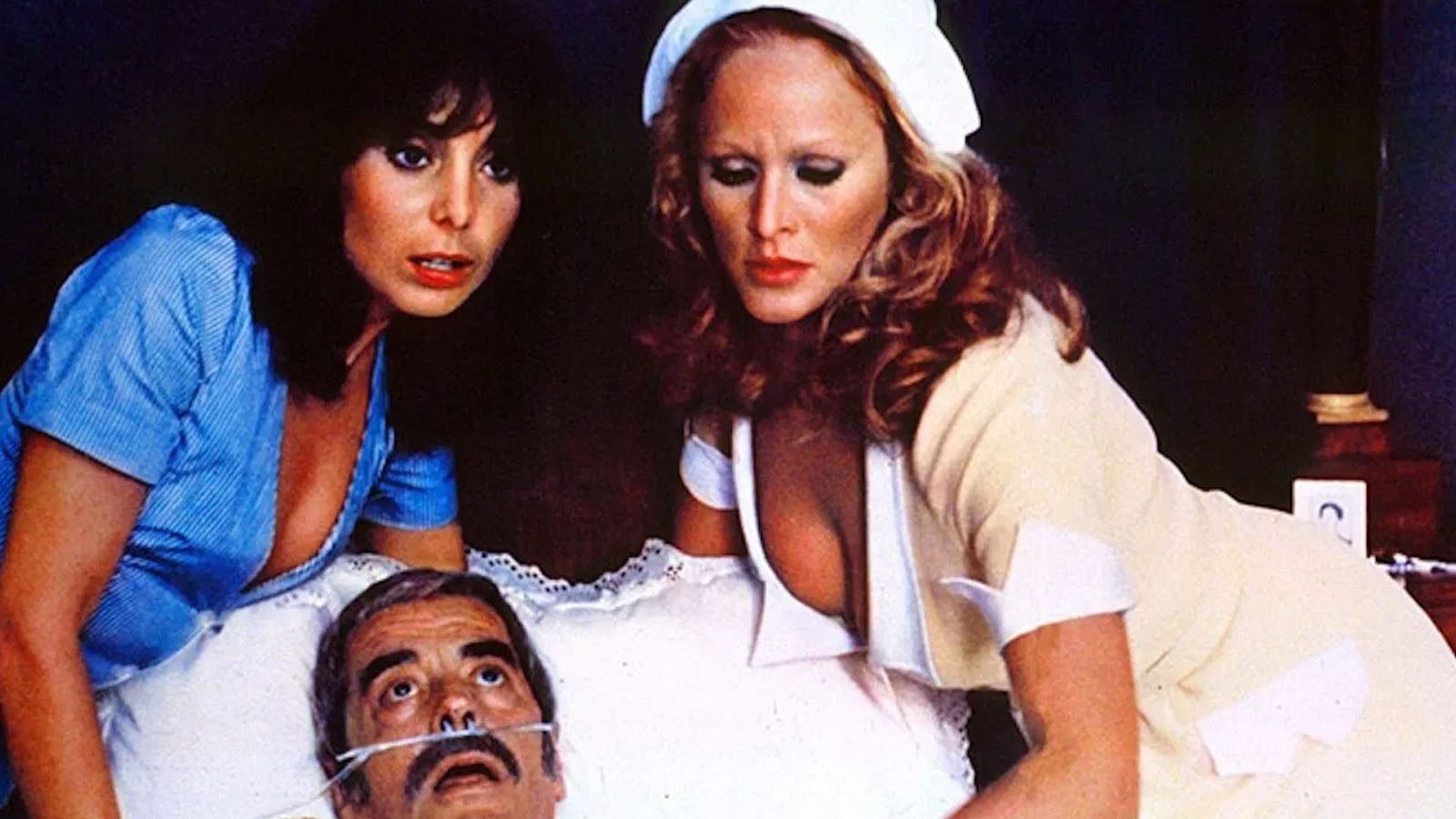
Italian cinema has produced its fair share of unconventional comedies, but L’infermiera (The Sensuous Nurse), released in 1975, is certainly an entertaining entry in the genre. Directed by Nello Rossati, the film brings together an unusual combination of family greed, sexual escapades, wine and an elderly millionaire whose recovery turns out to be everyone’s worst nightmare.
The story revolves around Leonida Bottacin, a wealthy industrialist who is seriously ill and confined to his bed. His family, rather than wishing him a speedy recovery, has other ideas. Hoping to hasten his departure from this world and secure their inheritance, they decide to employ an attractive nurse, Anna (Ursula Andress). The plan is simple: let the old man enjoy her company for a while and then abruptly dismiss her. The resulting emotional shock, they believe, might trigger another fatal heart attack.
Unfortunately for the family, things do not go according to plan.
Anna arrives at the sprawling Bottacin residence with considerable enthusiasm and begins looking after the ailing millionaire. She is not entirely unfamiliar with the household either, having previously been involved with Benito Varotto, one of Bottacin’s relatives.
But before getting too deeply involved in Anna’s nursing duties, there is another character worth mentioning: Tosca Floria, played by Carla Romanelli. She is the housemaid, and arguably one of the most memorable characters in the film. In fact, I would go as far as saying that she is the most visually appealing woman in the entire household.
And there is a good reason why alcohol occupies such an important place in the story. The Bottacins made their fortune in the distillery business and operate a wine-producing establishment on their enormous farmhouse property. Tosca, naturally, has developed a particular fondness for the family’s stock.
Her relationship with alcohol is rather straightforward. She is willing to offer her company to practically anyone who allows her access to the wine cellar. She drinks, laughs, sings, giggles, undresses and eventually finds herself in the company of another household member. It is a recurring comic routine, and Romanelli plays the character with considerable mischief.
I seem to have become rather distracted by Tosca. Let us return to the actual film.
There is also a young man in the household, Adone, who develops an immediate attraction towards Anna. His romantic hopes, however, suffer a considerable setback when he catches her in an intimate encounter with his uncle Benito. The poor fellow is devastated.
Benito, apparently sympathetic to the young man’s disappointment, sends Anna to Adone’s room to cheer him up. And cheer him up she certainly does.
When Anna enters the room, Adone refuses even to look at her. She proceeds to undress and gets into bed, gradually drawing the young man into an encounter he probably never imagined would happen. Adone initially calls her a whore, but his anger and frustration soon give way to passion. It is an amusingly outrageous episode, typical of the film’s rather uninhibited approach to sexuality.
Meanwhile, something entirely unexpected is happening to the family’s original plan. Bottacin, who was practically bedridden when Anna arrived, begins showing remarkable signs of recovery. He gradually regains his strength and eventually starts walking on his own.
Anna, it seems, has accomplished what the family never wanted: she has brought the old man back to life.
The relatives are understandably furious. Their carefully calculated inheritance scheme is falling apart, and the nurse they hired to accelerate Bottacin’s demise has instead become responsible for his recovery.
Eventually, Bottacin discovers that his family has been plotting against him. Anna reveals the truth, and the old millionaire decides to take matters into his own hands. He marries her and takes her to an expensive hotel for their honeymoon.
There is, however, one final complication. Bottacin wants to consummate the marriage, but Anna is reluctant to entertain his advances. After considerable persistence, the old man finally succeeds in getting what he has been hoping for. Unfortunately, the excitement proves too much for his recovering heart, and he suffers a fatal heart attack.
His happiness, quite literally, lasts only a few moments.
One could argue that Bottacin gets his happy ending, even if it is not exactly the ending his family had originally planned for him.
As for the performances, Ursula Andress brings considerable screen presence to the role of Anna, although I found myself wishing that Carla Romanelli had been cast as the nurse instead. Romanelli has a particularly striking screen presence, and I suspect the film would have been an even more enjoyable visual experience with her in the central role. Andress is attractive in her own right, but her character’s appearance and screen persona did not quite appeal to me as much as Romanelli’s portrayal of Tosca.
The Sensuous Nurse is not a film one should approach expecting sophisticated storytelling or particularly subtle humour. Its appeal lies in its absurd premise, exaggerated characters, sexual comedy and the delicious irony of a family becoming increasingly desperate because their supposedly dying millionaire refuses to die.
It is a light-hearted, occasionally ridiculous Italian comedy that knows exactly what sort of entertainment it wants to offer. And, judging by the number of unexpected bedroom encounters, it certainly does not believe in keeping its audience waiting.