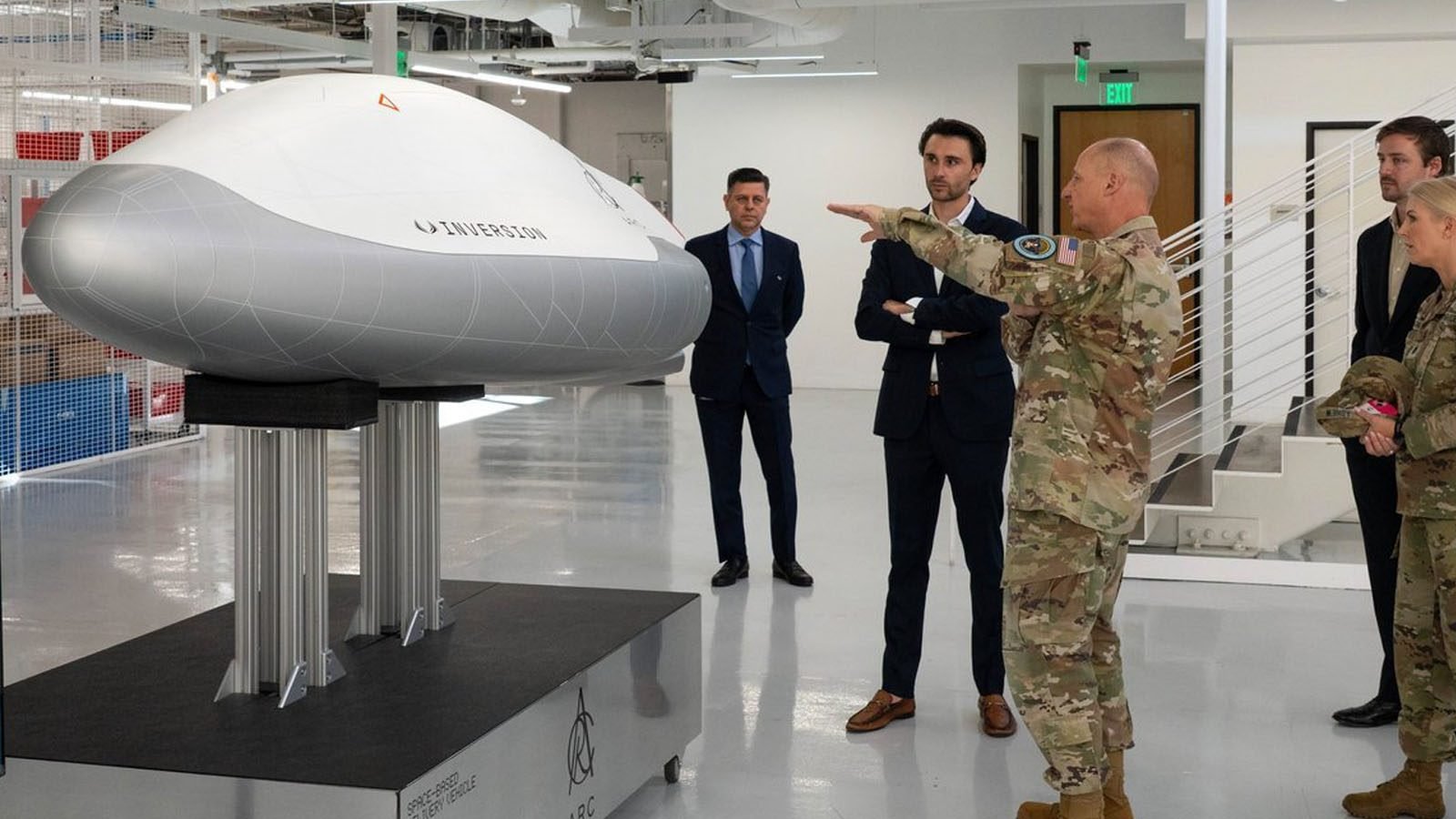
WASHINGTON: US aerospace and defence company Inversion Space is developing an autonomous, reusable spacecraft designed to deliver critical cargo from orbit to virtually any location on Earth in less than an hour, potentially transforming military logistics and rapid-response operations.
Known as Arc, the space-based delivery vehicle is designed to be pre-positioned in Low-Earth Orbit (LEO), where multiple spacecraft would form constellations capable of providing on-demand global delivery services.
According to the company, the system would allow mission-critical supplies to reach remote, infrastructure-limited or restricted areas without relying on conventional transportation routes.
Unlike traditional satellite systems, Arc is designed to return from orbit and deliver cargo directly to designated locations on Earth.
Beyond cargo delivery, Arc is being developed to support hypersonic testing and advanced orbital operations.
Inversion says the spacecraft can manoeuvre at speeds exceeding Mach 20, providing a platform for testing next-generation hypersonic technologies and replicating potential threat trajectories.
The vehicle is also designed to capture and deploy space-based assets, rendezvous with other spacecraft and operate in orbit for up to five years.
The project has attracted attention from the US defence sector. In September 2025, Inversion was selected by defence company Kratos to participate in the $1.45 billion MACH-TB 2.0 hypersonic testing programme.
In September 2026, the company also announced a NASA contract to study how Arc’s re-entry technology could support future aerocapture missions, including potential applications in interplanetary exploration.
Inversion’s longer-term vision is to establish a network of reusable spacecraft in orbit, creating a new logistics infrastructure capable of delivering essential equipment rapidly across the globe.
If successfully developed and deployed at scale, Arc could offer military and commercial operators an alternative way to transport high-priority cargo, while expanding the strategic and logistical applications of space technology.
However, the proposed global delivery network remains a development ambition rather than an operational service.