MOSCOW: Russia has called for closer military and political cooperation across Eurasia, with Foreign Minister Sergey Lavrov urging regional countries to develop a coordinated security framework as Moscow hosted a high-level meeting of the Collective Security Treaty Organisation (CSTO).
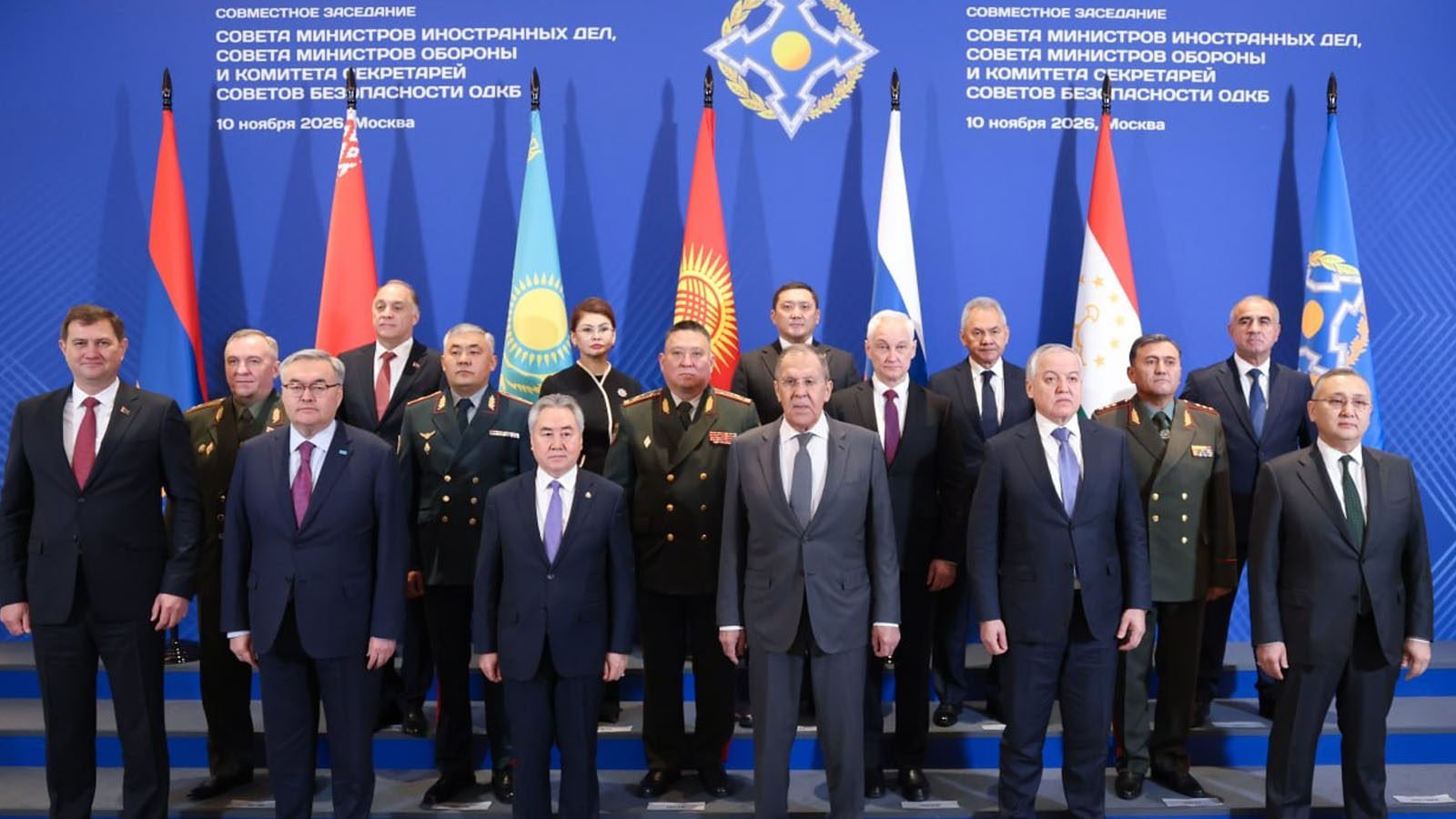
Lavrov chaired a joint meeting of the CSTO Council of Foreign Ministers, Council of Defence Ministers and Committee of Secretaries of Security Councils on November 10, bringing together senior representatives of member states to discuss regional security challenges and strengthen cooperation.
CSTO Secretary General Taalatbek Masadykov, who assumed office on January 1, 2026, also attended the meeting.
The discussions focused on the security situation across the organisation’s area of responsibility and neighbouring regions, with participants reaffirming their commitment to addressing emerging threats through closer coordination.
These challenges include the growing risk of armed conflict, terrorism, drug trafficking, illegal migration and crimes involving information and communications technologies.
Moscow seeks a new Eurasian security architecture
Addressing the International Collective Security Forum in Moscow, Lavrov renewed Russia’s call for a new security architecture across Eurasia based on the principles of equal and indivisible security.
He criticised Western countries for rejecting previous Russian proposals for a treaty-based security framework in Europe, arguing that no country or organisation should strengthen its security at the expense of others or seek regional dominance.
Lavrov referred to Russia’s December 2021 security proposals, claiming that Moscow had attempted to prevent an escalation of the conflict in Donbas but that its concerns had been ignored by Western governments.
He also acknowledged fundamental differences between Russia and the administration of US President Donald Trump over international politics, while maintaining that dialogue between Moscow and Washington remained necessary.
The Russian foreign minister argued that communication should continue even amid serious geopolitical disagreements, pointing to the importance of maintaining military contacts during the Cold War.
Push for stronger CSTO military capabilities
The joint meeting reviewed several measures aimed at strengthening the organisation’s military and security capabilities.
Participants endorsed proposals to develop the CSTO’s Collective Aviation Forces, improve air defence capabilities and strengthen biological security across the organisation’s area of responsibility.
They also reviewed documents and draft decisions for submission to the CSTO Collective Security Council, the organisation’s highest decision-making body.
The meeting further discussed closer cooperation among member states to counter terrorism, transnational crime and other security threats.
Lavrov proposes closer Eurasian integration
Lavrov also called for stronger coordination among existing regional organisations, arguing that Eurasia needed closer institutional links to improve security, economic cooperation, transport networks and logistics.
He referred to cooperation between the CSTO, the Commonwealth of Independent States (CIS), the Shanghai Cooperation Organisation (SCO) and the Eurasian Economic Union (EAEU).
He said Russia was not proposing the creation of another international organisation but wanted to strengthen existing partnerships through what he described as the “integration of integrations”.
Lavrov pointed to cooperation between the EAEU and ASEAN, as well as links involving the SCO, CIS and CSTO, as examples of regional integration already taking shape.
He argued that better coordination could reduce duplication, improve the use of resources and support the development of transport routes across the continent.
Tajikistan to chair CSTO in 2027
The meeting also focused on the CSTO’s future priorities, with Tajikistan’s Foreign Minister Sirojiddin Muhriddin outlining his country’s plans for its 2027 chairmanship.
Participants endorsed a draft agreement concerning the CSTO Parliamentary Assembly as the organisation marks the 20th anniversary of its establishment.
They also prepared a programme of events for 2027 to commemorate 35 years since the signing of the Collective Security Treaty and 25 years since the establishment of the CSTO.
Documents concerning the staffing of the organisation’s permanent bodies will also be submitted to member states’ leaders for consideration.
The next meeting of the CSTO Council of Foreign Ministers is scheduled to take place in Tajikistan during the first half of 2027.