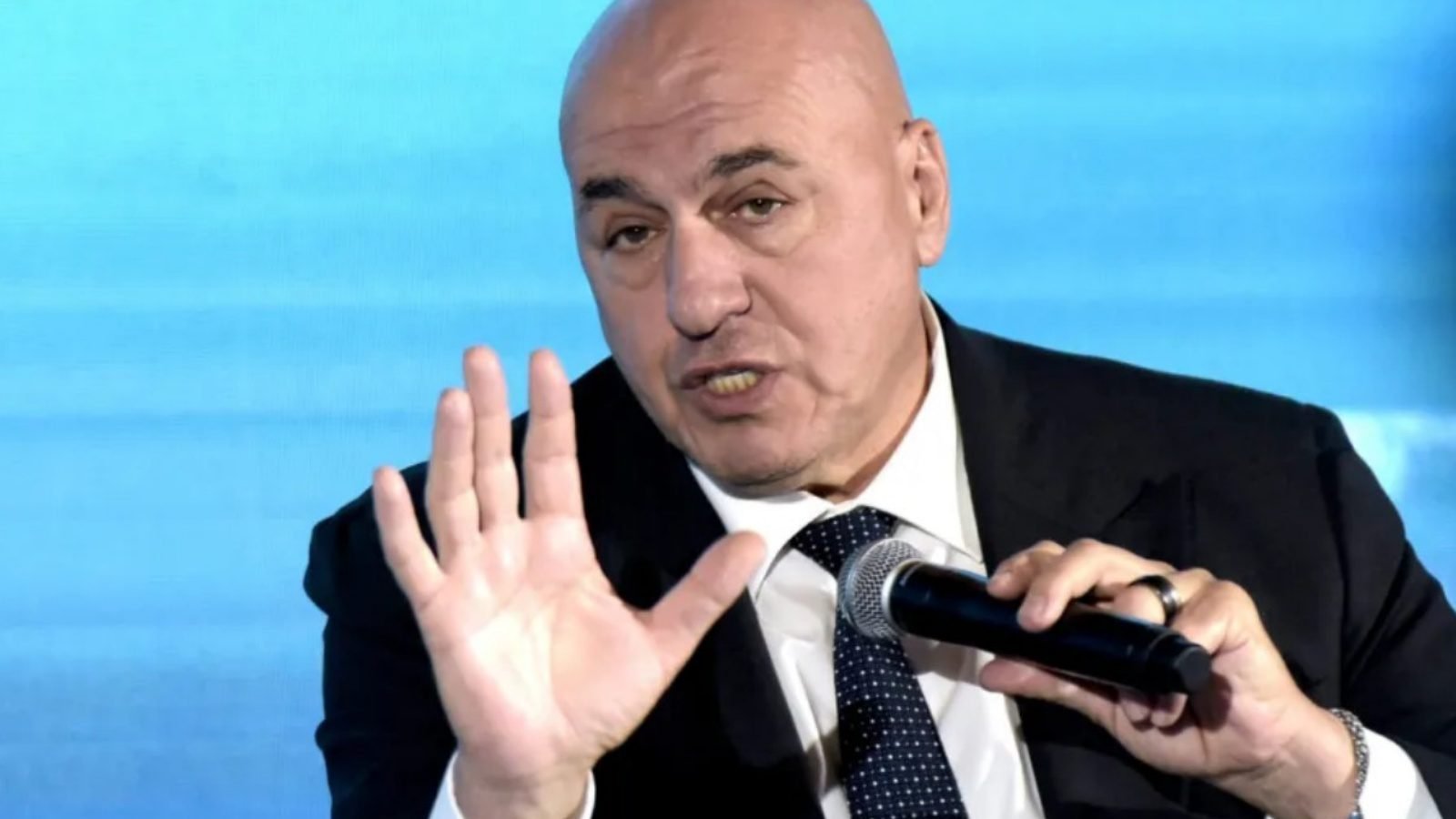
Italy’s defence minister has criticised US President Donald Trump over reported restrictions on Ukraine’s access to satellite systems and intelligence, warning that weakening Kyiv’s defences could prolong Russia’s war rather than bring peace.
In an exclusive interview with the BBC, Guido Crosetto described any move by Washington to limit Ukraine’s access to critical intelligence capabilities as a “complete mistake, a major mistake”, arguing that the decision would undermine efforts to persuade Russian President Vladimir Putin to negotiate.
Trump has denied asking for satellite access to be suspended.
Crosetto said reducing Ukraine’s ability to defend itself would send the wrong signal to Moscow by encouraging Putin to believe that Russian forces could achieve victory on the battlefield.
“If [Putin] sees weakness on the Ukrainian side – and if the US deprives Ukraine of resources, that creates weakness – then he will believe he can win. So he will continue the war,” Crosetto told the BBC.
“I think that is completely wrong,” he added.
The remarks mark a further hardening of Italy’s criticism of Washington, with Prime Minister Giorgia Meloni also questioning Trump’s reported agreement to purchase diesel from Russia amid the ongoing conflict.
Meloni challenges Trump’s Russia policy
Earlier in the week, Meloni described Trump’s reported fuel deal with Putin as a “very risky choice”, arguing that it would grant Russia greater legitimacy while Russian forces continued attacks on Ukrainian cities.
Trump had blamed Ukrainian attacks on Russian oil refineries for rising fuel prices, according to the BBC report.
Meloni, once regarded as one of Trump’s closest European allies and dubbed a “Trump whisperer”, has maintained support for Ukraine despite growing domestic opposition to military assistance.
Crosetto argued that a sustainable peace would require Putin to conclude that Russia could no longer make further territorial gains.
“Peace will come when Putin is convinced there is a stalemate, that he cannot advance any further,” he said.
A co-founder of Meloni’s Brothers of Italy party, Crosetto has served in a government coalition that has supported Ukraine with military and humanitarian assistance since taking office in 2022. Details of Italy’s military deliveries have remained classified.
The minister pledged that Italian military support would continue for as long as the current government remained in power, although he acknowledged that securing parliamentary approval for further deliveries could become more difficult as elections approached.
Public opposition threatens Ukraine aid
Italy’s continued support for Kyiv faces significant domestic political challenges, with public opinion polls indicating widespread opposition to further arms deliveries.
A September poll conducted for the Ixè institute found that only 18% of respondents supported continuing to supply weapons to Ukraine, according to the BBC.
The opposition reflects a combination of Italy’s pacifist traditions, longstanding economic ties with Russia, concerns over rising energy costs and a perception that the war poses a less immediate threat to Italy than to countries closer to Russia.
The political pressure could intensify ahead of the next parliamentary election, which must take place by the end of 2027.
Futuro Nazionale, a new right-wing party led by former general Roberto Vannacci, has emerged as a challenge to Meloni’s coalition partners. Vannacci opposes military assistance to Ukraine and has argued that European spending on the conflict is wasteful while Russian forces continue to advance.
At a recent event in Tuscany, he described himself as “neither pro-Putin nor pro-Russian” but “pro-Italian”.
Crosetto declined to engage extensively with questions about Vannacci’s position, saying he had more serious matters to address.
He nevertheless issued an unequivocal condemnation of Russia’s military campaign.
“When one state crosses another state’s border with tanks, when it bombs hospitals and schools, kills civilians and bombs power plants, and has been doing so for four years, I can only describe that as evil,” he said.
Energy costs fuel public anger
The war’s economic consequences have added to the political strain, with Italians facing higher energy and fuel costs.
During street protests in Rome, students complained that government resources were being directed towards weapons rather than education. Some demonstrators chanted: “We want more classroom, not more bombs.”
Truckers in southern Italy have also begun blocking roads in protest against rising fuel prices.
Crosetto acknowledged the difficulty of persuading households struggling with energy costs to support continued assistance to Ukraine.
“It’s very hard to explain to a citizen who’s having trouble at the petrol pump that we can’t give any concessions to Russia right now,” he told the BBC.
“But that’s the only way to defend the future of that very citizen who’s complaining.”
The minister also accused Moscow of conducting a disinformation campaign aimed at weakening European political support for Ukraine, alleging that Russia was targeting political figures and public debate to shift opinion in its favour.
Italy warns of Russian cyberattacks
Crosetto said cyberattacks believed to be linked to Russia had become routine, with “hundreds every day”, and argued that Europe had responded too weakly to the threat.
He also addressed reports of potential Russian sabotage operations in Europe, saying a fire at an arms depot outside Rome in August was caused by “human stupidity” rather than arson.
A separate report suggesting Russia planned to launch drone attacks against Italy, France and Spain from container ships in the Mediterranean had not been proven, he told the BBC.
The minister warned that Europe could not expect to protect itself if it failed to respond effectively to hostile actions.
“You can’t win a war… if you don’t fight back,” he said.
Crosetto’s remarks underline the tensions confronting European governments as they attempt to sustain support for Ukraine while managing domestic opposition, rising living costs and uncertainty over the future of US assistance.